A ULV machine breaks the product into droplets so fine that they stay airborne for a while and settle on every surface — including those a hand cannot reach.
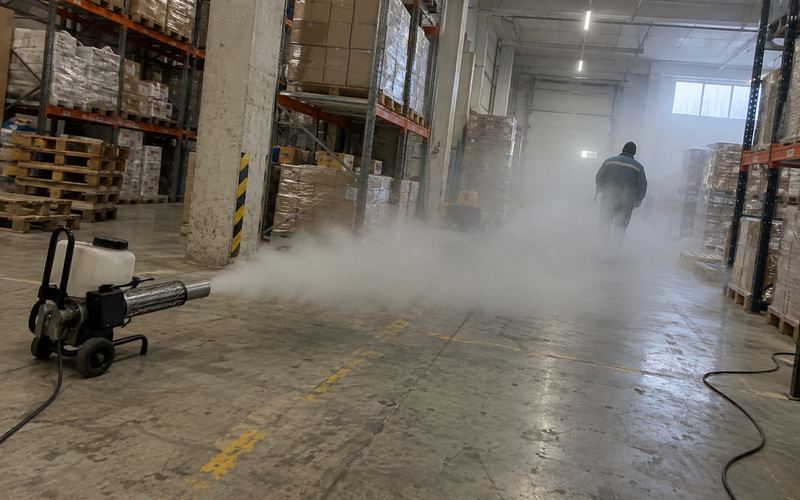
A cold fogging machine uses a strong airflow to break the disinfectant into very fine droplets. It is called "cold" because the product is not heated — the droplets are formed mechanically, by air pressure, rather than by temperature. That also means the active substance is never exposed to heat and its composition does not change.
The fine droplets stay airborne for a while, travel with the air currents in the room and gradually settle on every surface, including ceilings, the upper parts of walls, the undersides of shelves and the space behind furniture. That is the method's main benefit: one treatment covers the whole room, including what cannot be reached by hand.
At the same time the droplets are large enough to settle and stay on a surface. So, unlike ozone, a thin layer of the active product remains on surfaces and keeps working after the fog has settled.
The whole method rests on a balance between two opposing effects, and droplet size is what sets that balance.
From that comes the practical rule: during fogging the room must be kept closed, and after treatment the contact time must be observed before airing begins. If you air the room straight away, part of the product has not yet settled, and instead of working on the surface it goes out of the window.
The second practical rule: disinfection does not work on a dirty surface. If there is a layer of dust or grease on a shelf, the product settles on that layer rather than on the surface itself, and whatever is under the layer is untouched. That is why on large properties mechanical cleaning is often a separate step before fogging.
A typical situation: a 400 m² warehouse with high racking, where after flooding not only the floor but also the racking structures and the walls at full height have to be treated. By hand that would take several days; with cold fogging the treatment covers the whole space in one pass.
The other limit is the cause. If there is persistent damp or an unrepaired leak, fogging gives a clean surface for a while, but the fungus and bacteria will return, because the conditions they grow in have not changed. In that case we first say what needs sorting out, and only then offer a treatment.
Fog settles on the surface. That is both the strength of the method and its precise limit.
Because a thin layer of liquid is left on surfaces, the material has to be taken into account — even though the volume of liquid is so small that surfaces do not get soaked.
In terms of properties, the method pays off best where the area is large and there are many surfaces: warehouses, production facilities, gyms, shop floors, basements. It works in a small flat too, but targeted surface treatment is often enough there and takes the space out of use for less time.
There is one situation in which we do not recommend fogging at all: when the main problem is a smell. Fog settles on the surface and masks part of the smell with its own, but it does not break down odour molecules deep in textiles and upholstery filling. There the right method is ozone treatment, and we say so rather than selling a bigger job.
Uncovered food, medicines and cosmetics have to be taken out or sealed airtight.
Aquariums must be sealed and the pump switched off; animals and plants must be taken out.
We cover electronics and some sensitive surfaces.
Nobody may be in the room during treatment.
We air the room once the required contact time has passed.
We wipe down surfaces that come into contact with food after the treatment.
After treatment the room has to be kept closed for a set time so the product can settle and work, and only then do we air it. Surfaces that come into direct contact with food or skin — kitchen worktops, tables, the handle area of a pram — are wiped down afterwards. The other surfaces do not need washing, and it is in fact better not to, because that removes the active layer left behind.
The price depends on the floor area and the type of property. For flats and houses it goes by the number of rooms, from €55. For commercial premises it is €0.70 to €1.20/m² depending on the area. All prices →
No. What needs wiping down is surfaces that come into direct contact with food and skin — kitchen worktops, tables. The other surfaces do not need washing, because that would remove the active layer left behind.
We cover electronics before treatment. The method does not damage ordinary furniture and surfaces, because the volume of liquid is very small — surfaces do not get soaked.
Ozone is a gas that reaches everywhere the air reaches, then breaks down and leaves no residue — the best option against smells. Fog settles on surfaces and leaves a thin layer of active product that keeps working longer — better for microbiological treatment.
Describe the situation — we will tell you whether treatment is needed at all, and which one.
Fill in the form — we will call you on the number you provide, ask a few clarifying questions and propose a solution.
Thank you! We will contact you on the phone number you provided shortly.