In a basement, moisture comes from the ground and from airing the space the wrong way. In summer many people make it worse without realising, by opening the windows.
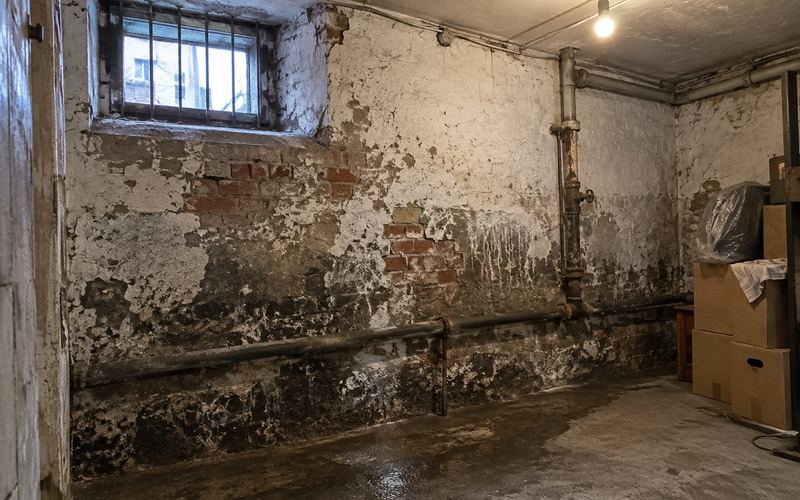
A basement is the coolest room in a building and the only one in contact with the ground. That means two permanent sources of moisture:
On top of that, a basement usually stores exactly the materials the fungus likes best: cardboard, paper, timber, textiles, leather shoes.
In a basement, damp is not an event but a permanent condition — which is why routine matters more here than treatment.
The age of the building changes the picture. In pre-war buildings the basement often has brick or fieldstone foundations and no horizontal damp-proofing at all — it simply was not built that way at the time. Such a basement is permanently damp, and that is a property of the structure rather than a defect that has developed.
In Soviet-era panel blocks the heating main and water pipes usually run through the basement, so the moisture source there is often a leak or condensation on cold pipes. In new builds, a basement or underground car park gives off construction moisture from thick concrete structures for the first few years.
Two completely different things are commonly visible on basement walls, and they are often confused.
There is no point treating salt efflorescence with an anti-mould product — it is not a living organism. But it is not worth ignoring either: salts are washed out of masonry only where moisture moves through the structure regularly. It points to a damp-proofing question.
On a hot summer day a basement is damp, and opening a window to air it out seems logical. In practice the opposite happens.
Warm outdoor air holds far more water vapour than the cool basement air. As it flows into the basement it cools — and the excess moisture settles on the cold walls. Airing a basement during the day in summer makes it damper.
The right way: in summer, air the basement early in the morning or at night, when the outdoor air is cooler. In winter, airing during the day works normally, because cold air is dry.
| Season | When to air | Why |
|---|---|---|
| Summer | Night / early morning | During the day, warm air brings moisture in and it settles on the cool walls |
| Winter | During the day | Cold outdoor air is dry and takes moisture out of the space |
| Spring / autumn | When the outdoor air is cooler than the basement | The same principle — cool air dries, warm air adds moisture |
You can test the same principle with two cheap hygrometers: one in the basement, one outside by the door. If the outdoor air is warmer than the basement air, airing will bring moisture in rather than take it out. If the outdoor air is cooler, airing dries the space. That is the whole rule, and it works all year round.
We measure moisture in the walls and the air, and determine whether it comes from the ground or from condensation.
We recommend removing affected cardboard boxes and textiles — they are food for the fungus.
We treat the walls, ceiling and affected structures.
In more extensive cases we use a cold fogger to treat the whole space.
Airing routine, storage solutions and, where necessary, a note that damp-proofing is needed.
If a basement has rising damp, we say so clearly: treatment will improve things for a while, but the lasting fix is damp-proofing. Promising otherwise would mean selling you a repeat call-out.
What affects the price in a basement: the area to be treated, access — whether the space has been cleared or is full of belongings — and whether the ceiling height allows normal working. Access is the most common factor that changes how long the job takes. If shelving is screwed to the wall and cannot be moved, the wall behind it stays untreated, and that is usually exactly where the fungus is worst.
What is stored in a basement is not a side issue — it is often the main food source. Fungus grows slowly on a concrete wall, but it grows fast on a cardboard box.
A practical example. A shared basement in an apartment block, a bay of roughly 6 m², walls grey with dark patches in the lower part, shelving screwed to the wall, cardboard boxes and old blankets on it. The readings show high moisture in the lower part of the wall and normal readings higher up — the classic picture of rising damp. Here treatment is impossible without clearing the belongings out, because they are exactly what the fungus is growing on, and they cover exactly the wall that needs treating.
Not every damp basement needs treating. If the readings show raised moisture but there is no fungus — only salt efflorescence and cool air — there is nothing to treat. In that case what makes sense is a change of routine: when to air, clearing belongings out, keeping gaps from the wall, unblocking ventilation openings.
There is equally no point in treatment if the basement has an active leak or groundwater ingress. While the water keeps coming, any treatment is only a pause. First stop the water, then dry, then treat — in that order and no other.
There is one thing worth not doing in a basement: do not insulate the walls from the inside with polystyrene or mineral wool without a proper design. Internal insulation makes a cool wall cooler still, and the condensation moves behind the insulation where nobody can see it. That is one of the most common ways an attempt to solve the problem makes it worse.
Basement treatment from €1.20/m², minimum order from €80. For shared basements in apartment blocks we prepare a quote after the inspection — these are often commissioned by the property manager.
Yes, and that is typical. The fungus can be growing behind shelving, under the floor covering or inside the structure. The characteristic smell often appears before any visible patches.
It keeps humidity under control while it runs, and it is a useful measure. But it does not stop rising damp if that is present — that is a damp-proofing question.
Yes. This kind of work is usually commissioned by the property manager or the residents' representative. After the inspection we prepare a quote with the scope of work.
Describe the situation — we will tell you whether treatment is needed at all, and which one.
Fill in the form — we will call you on the number you provide, ask a few clarifying questions and propose a solution.
Thank you! We will contact you on the phone number you provided shortly.