Black grout and the silicone around the bath are the most common places for mould in a flat — and the only ones where replacing the material really does help more than cleaning it.
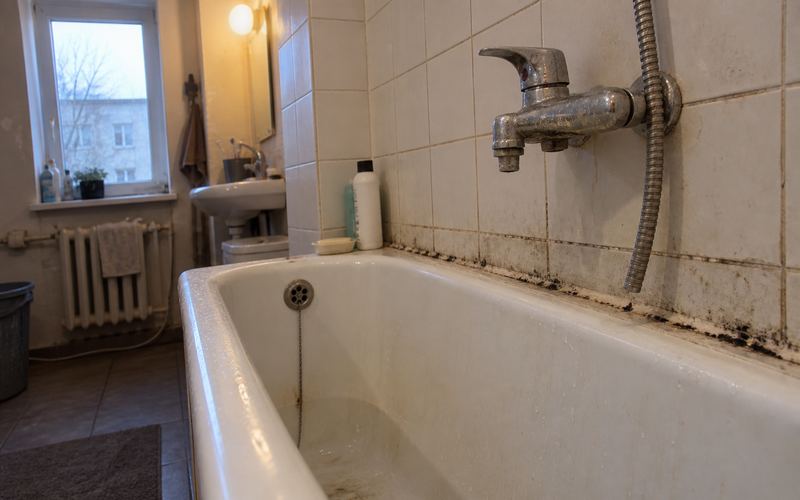
A bathroom is a room where humidity rises sharply several times a day and then falls slowly. If it falls too slowly — that is, if the ventilation cannot carry the moisture away — surfaces stay damp long enough for the fungus to grow.
So mould in a bathroom is not a question of hygiene. A spotless bathroom with poor ventilation will get mould; a moderately clean one with good ventilation will not.
The fungus grows not because a surface gets wet, but because of how long it stays that way.
After a hot shower the relative humidity in a bathroom comes close to saturation for a while. That in itself is not a problem — the room is designed for it. The problem starts when an hour later the reading is still just as high, and the next shower starts from an already elevated level. That is how moisture accumulates, and the grout, the silicone and the ceiling stay wet essentially without a break.
Building type matters here. In Soviet-era panel blocks the bathroom is usually windowless, served by a shared ventilation shaft, and is one of the smallest rooms in the flat — a small volume means humidity rises in it faster. In pre-war buildings the bathroom was often fitted later by converting a room, and there may be no duct at all — only a door onto the hallway. New builds have a duct, but in the first years construction moisture from the structure is added on top.
These are two separate problems, and only one of them can be solved by cleaning.
Silicone joints. Once silicone has gone black, the fungus has grown into the material. No product will draw it back out — a product may lighten the patch, but the fungus stays and returns. The only real solution is to cut the old silicone out, treat the surface and apply new.
Tile grout. Grout is porous but far more durable than silicone. Grout can usually be treated and recovered if the fungus has not gone too deep. If the joint is crumbling or dark all the way through, it is better to renew that too.
| Material | Can treatment save it | What we do |
|---|---|---|
| Silicone joint, black all the way through | No | Cut it out, treat the substrate, apply new |
| Tile grout, darkened at the surface | Yes | Treat and clean it |
| Tile grout, crumbling | Partly | Treat it, and we advise renewing the grout |
| Painted ceiling | Yes | Treat it, then it can be repainted |
| Plasterboard finish with fungus inside | No | Cut out the affected section |
A common mistake is applying new silicone over the old, or onto a damp substrate. The new silicone goes black within weeks, and people conclude that "the silicone was bad". The silicone was not bad — fungus and moisture were left underneath it. Before new silicone goes on, the joint has to be cut back to clean material, treated and dried.
Not every darkening in a joint is fungus, and whether treatment will help at all depends on that.
The practical test is simple: clean a small area and note the date. Limescale and dirt do not return once removed. Fungus comes back in exactly the same place, because the moisture that feeds it is there.
Before you think about treatment, check the extract. It takes a minute:
The last two points surprise people most often. After a door is replaced without a gap at the bottom, bathroom ventilation practically stops. And after all the windows in a flat are replaced, the extract stops working in every room at once, because natural ventilation was designed on the assumption that air comes in through gaps around the windows.
We assess the affected surfaces and check that the ventilation works.
We cut out the affected silicone — cleaning it is not possible.
We treat the grout, the ceiling and any other affected surfaces.
If a damp smell remains in the room, we treat it with ozone.
We tell you what to fix in the ventilation so the problem does not repeat.
What we do not do in this room: we do not fit fans, clean ventilation shafts or carry out plumbing repairs. If at the inspection we see that the duct is blocked or that a powered extract fan is needed, we say so and state what has to be dealt with, but the fix itself is another trade's work.
There is one more thing we will not do, even when asked: we do not apply new silicone on the same day the old was cut out if the substrate is still damp. Silicone needs a dry surface, otherwise the whole cycle starts again.
A bathroom is usually a small room, so the work falls within the minimum order — from €80. If silicone has to be replaced or grout more extensively renewed, we assess that on site.
Because the fungus grows inside the silicone, not on its surface. Cleaning removes dirt from the surface but never reaches the fungus inside the material.
As long as it is intact and not black, it does not need replacing at all. If it goes black within a few months of being replaced, the problem is the ventilation, not the silicone.
Ozone treatment clears damp and mould smells well and reaches places that are hard to get at, but it does not replace removing affected material and it does not solve a ventilation problem.
Describe the situation — we will tell you whether treatment is needed at all, and which one.
Fill in the form — we will call you on the number you provide, ask a few clarifying questions and propose a solution.
Thank you! We will contact you on the phone number you provided shortly.