It shows up most often on external walls, in corners and behind furniture — and the reason is almost always condensation, not dirt.
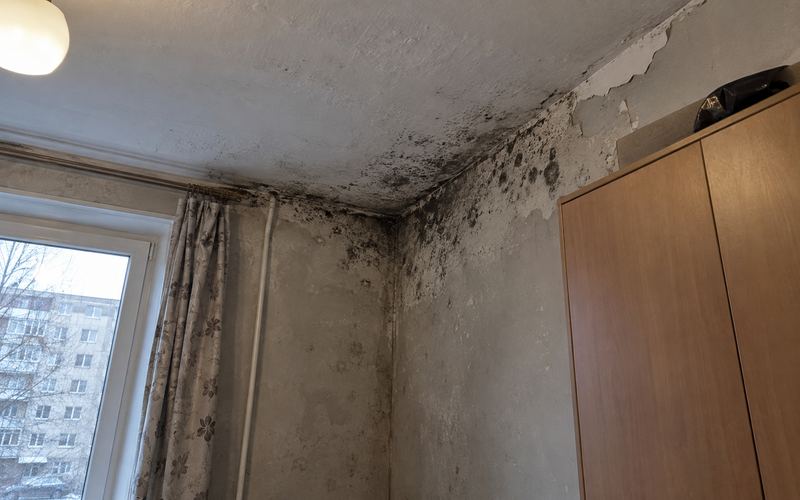
On a wall, mould grows where the surface temperature is below the dew point of the air. Put simply: the wall is cold enough for moisture from the indoor air to settle on it. This happens a little every day, and after a while a patch appears.
That is why mould is almost always on external walls rather than internal partitions. An internal wall is as warm as the room — condensation does not form on it. If a patch does appear on an internal wall, it almost always means a leak in the structure or moisture coming up from the floor.
The second most common reason is a leak: a damaged pipe inside the wall, a crack in the external render, flooding from above. In that case the moisture comes from inside the structure, and the patch is often larger than it looks from the outside.
The corner of an external wall is several degrees cooler than the middle of the wall — and that difference is what decides whether condensation forms.
In a corner, heat escapes in two directions at once, so the surface there cools the most. The same effect occurs at the edge of a floor slab, at a balcony slab that passes through the wall, and at steel reinforcement in a panel joint. In construction all of these are called cold bridges, and they are exactly the places where mould appears first.
The same picture — a dark patch in an external wall corner — arises for different reasons in three Riga building types, and that changes the solution.
That is why at an inspection we always ask what kind of building it is, when the windows were replaced and whether the facade is insulated. Those three questions narrow the range of possible causes before we have touched the wall.
| Location | What it usually means |
|---|---|
| External wall corner | Cold bridge — the wall cools most in the corner |
| Behind a wardrobe or sofa against an external wall | Air does not circulate, the wall behind the furniture is cooler |
| Under a window / at the edge of the sill | Condensation from the window, sometimes a failed seal |
| Lower part of the wall at floor level | Rising damp or a leak at floor level |
| A patch mid-wall with no pattern | Most often a leak inside the structure |
If the mould is in one specific spot, it points to a local problem — a cold bridge or a leak. If it is scattered around the whole room, the problem is air exchange and the overall moisture level.
A concrete example from a typical Riga flat. A 54 m² two-room flat in a panel block in Purvciems, the corner of the bedroom's external wall, a patch of roughly 0.5 m². The windows were replaced four years ago, the bed stands against the external wall, and laundry is dried in the bedroom. Humidity in the room is 72%, and the kitchen extract will not hold a sheet of paper.
There is no leak here and nothing wrong with the building — there is an airtight room that receives moisture every night from breathing and from laundry, with nowhere for it to go.
Not every dark or white area on a wall is fungus, and a wrong diagnosis leads to unnecessary treatment.
Salt efflorescence is especially common at basement level in pre-war buildings and on brick walls. It is not a fungus, but it is a sign of moisture: salts are washed out of masonry only where water is moving through it. So it is a reason to check the structure, not a reason to treat.
First we measure — both the moisture in the wall material and the humidity of the air in the room. That shows whether we are dealing with condensation or a leak, and it changes everything that follows.
We determine moisture in the material and in the air, and find the coldest zones.
If the fungus has got into wallpaper or plaster, we remove the affected layer.
We treat the surface and a band around the visible area with a professional product.
If the wall is damp, we dry it out before any redecoration.
We tell you what has to change so the patch does not come back.
After treatment the wall is ready for redecoration. Painting or hanging wallpaper is only allowed once the moisture readings are back to normal — otherwise the fungus will appear under the new finish.
How wide an area we work on is decided by the material. On a painted, dense wall, treating the surface and a band around the patch is often enough. Wallpaper with fungus always has to come off — the fungus grows both in the paper itself and in the adhesive layer beneath it. Plasterboard with fungus in the paper facing usually has to be cut out, because its core holds moisture for a long time.
If the patch is small, has only just appeared and is on a smooth, non-porous surface, you can try to deal with it yourself. What matters:
Before that, a few checks are worth doing — they cost nothing and often point straight at the cause:
What you cannot handle yourself: mould under wallpaper or finishes, mould over an area larger than about half a metre, and mould that keeps coming back. In those cases the material has to be removed and the moisture source dealt with.
There are also cases where we tell you no treatment is needed. If the readings show normal moisture levels, the patch is dry and no longer growing, and it is simply an old stain, treatment changes nothing — redecorating is enough.
Inspection with moisture readings from €40. Treatment from €1.50/m², minimum order from €80. If finishes have to be stripped or drying is required, we assess that on site and agree it before starting work.
No. The fungus grows in the wallpaper material and in the adhesive beneath it, so treating over the top changes nothing. Affected wallpaper has to come off.
Considerably further than you can see. The fungus spreads through the material before it becomes visible on the surface, so we treat a sufficient band around the affected zone.
Only once the moisture readings are back to normal. Paint a damp wall and the mould will appear under the new layer.
Describe the situation — we will tell you whether treatment is needed at all, and which one.
Fill in the form — we will call you on the number you provide, ask a few clarifying questions and propose a solution.
Thank you! We will contact you on the phone number you provided shortly.